Modeling
The four families of data mining models: classification, regression, clustering, and association rules — what each predicts and how to choose.
3 min read · Updated August 8, 2026
Modeling is the stage of the Data Mining Map where patterns stop being observations about the past and become reusable machinery. A model is a compact, learned representation of a relationship in data — compact enough to apply to new cases in milliseconds, and faithful enough to the data to be trusted.
Predictive modeling is the process by which a model is created to predict an outcome. What kind of model you build depends on one question: what does the outcome look like?
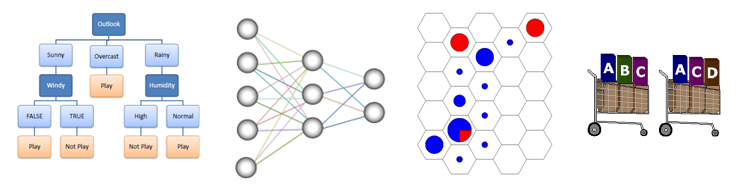
The four families
Classification — the outcome is categorical. A classifier learns to assign new observations to one of a fixed set of classes: fraudulent or legitimate, churn or stay, spam or not. The family runs from simple baselines (ZeroR, OneR) through naive Bayes, decision trees, logistic regression, and k-nearest neighbors to neural networks and support vector machines.
Regression — the outcome is numerical. A regression model predicts a quantity: revenue, temperature, a biomarker level. Techniques include multiple linear regression, decision tree regression, k-NN regression, and support vector regression.
Clustering — there is no outcome at all. Descriptive modeling assigns observations to clusters so that observations within a cluster are similar to each other and dissimilar from the rest. The main approaches are hierarchical clustering, k-means, and self-organizing maps.
Association rules — the goal is co-occurrence: finding interesting associations among observations, classically items that appear together in market baskets.
One dataset, four questions
The same table of historical data can feed all four families — the difference is the question asked of it. Consider a retailer’s transaction log:
| Question | Family | Model output |
|---|---|---|
| Will this customer churn this quarter? | Classification | churn / stay |
| How much will this customer spend next month? | Regression | a dollar amount |
| What natural segments exist among our customers? | Clustering | segment assignments |
| Which products are bought together? | Association rules | if A then B, with confidence |
In practice
scikit-learn mirrors this taxonomy almost exactly: its estimators are split into sklearn.linear_model and friends for classification and regression, sklearn.cluster for clustering, with association rules handled by libraries like mlxtend.frequent_patterns (Apriori). For tabular classification and regression, gradient boosting (XGBoost, LightGBM) is the default first serious model; deep learning dominates when the inputs are images, text, or sequences. Whatever the family, the model is only as trustworthy as its evaluation.
Common pitfalls
- Choosing the family before defining the outcome variable — a problem definition failure, not a modeling one.
- Reaching for the most complex technique first, with no baseline like ZeroR to beat.
- Clustering or mining rules on unscaled, unencoded data — preparation comes first.
- Treating a descriptive model (clusters, rules) as if it made validated predictions.
Summary
Modeling turns explored, prepared data into reusable predictive or descriptive machinery. The choice of family follows the shape of the outcome: classification for categories, regression for numbers, clustering and association rules when there is no outcome at all. Every family gets its own section of this guide, and every model must face evaluation before deployment.